Vodka sauce in NYC: five versions, and why nobody agrees where it came from
Tony Marchetti · July 31, 2026 · 6 min read
Vodka sauce is younger than most of the people ordering it. It shows up on menus in the 1970s and 1980s, which by the standards of Italian cooking makes it an infant, and its origin is still argued over by people with something at stake. What is not in dispute is that it took hold in New York harder than almost anywhere, and that a certain generation of us grew up thinking it had always been there. Below is what the vodka is actually doing in the pan, and five Manhattan menus currently running a version.
Quick answer
For the plain tavern reading, Pete’s Tavern on East 18th Street. For the version most New Yorkers picture, the rigatoni at Isabelle’s Osteria on Park Avenue South. For a snail-shell shape that traps more sauce than rigatoni does, Rubirosa in Nolita. For vodka sauce on chicken parmigiana, Zero Otto Nove in the Flatiron. For the expensive outlier, a smoked vodka sauce on a whole lobster at Don Angie in the West Village.
What the vodka is for
The usual explanation, that the alcohol cooks off and the vodka is therefore pointless, misses what it does on the way out. Several of the aromatic compounds in tomato are soluble in alcohol but not in water or fat, so a splash of spirit pulls out flavours that oil and cream leave sitting in the pan. The vodka also helps the cream and the tomato hold together instead of splitting, which is why a good vodka sauce is glossy and a bad one looks curdled at the edges.
That is the technical case. The practical case is simpler: it makes tomato sauce taste more like tomato, and it makes cream taste like less of an apology.
Where the dish comes from, honestly
Nobody has settled this. There are competing claims on both sides of the Atlantic, with Roman restaurants and New York restaurants each named as the source depending on who is telling it, and dates ranging across the 1970s and early 1980s. There is also a persistent and unproven story about a vodka company funding the whole thing as a marketing exercise, which is either true or exactly the kind of thing that sounds true.
What matters more for anyone eating in Manhattan is that the dish is not an import that got Americanised. It arrived roughly when the people cooking it here were already New Yorkers, which puts it in the same family as the Sunday sauce and the chicken parm: Italian in vocabulary, local in fact.
Where to order rigatoni alla vodka in NYC
Pete’s Tavern, 129 East 18th Street
The straight version, listed as Rigatoni Alla Vodka on an all-day menu that also carries spaghetti and meatballs, chicken parmigiana and eggplant parmigiana with spaghetti pomodoro. The room has been trading since 1864 and the food is Italian-American without irony about it. It runs noon to 2am seven days, with the kitchen closing at 11pm on weeknights and midnight on Fridays and Saturdays, so this is also the version you can get latest.
Best suited to: the meal where you want the dish exactly as you remember it and nothing clever done to it.
Rubirosa, 235 Mulberry Street
Listed as Lumache alla Vodka, with vodka sauce and parmigiano. Lumache are snail shells, and they hold sauce inside the shell as well as on the ridges, which means every forkful is wetter than rigatoni delivers. The menu notes that all the house pastas contain eggs except the lumache and the cavatelli, which is worth knowing if you are ordering around an allergy. The same kitchen runs vodka sauce on two pizzas, including one called the TIE DYE with pesto swirled through it.
Best suited to: anyone who has decided rigatoni is not holding enough sauce, which is a legitimate position.
Isabelle’s Osteria, 245 Park Avenue South
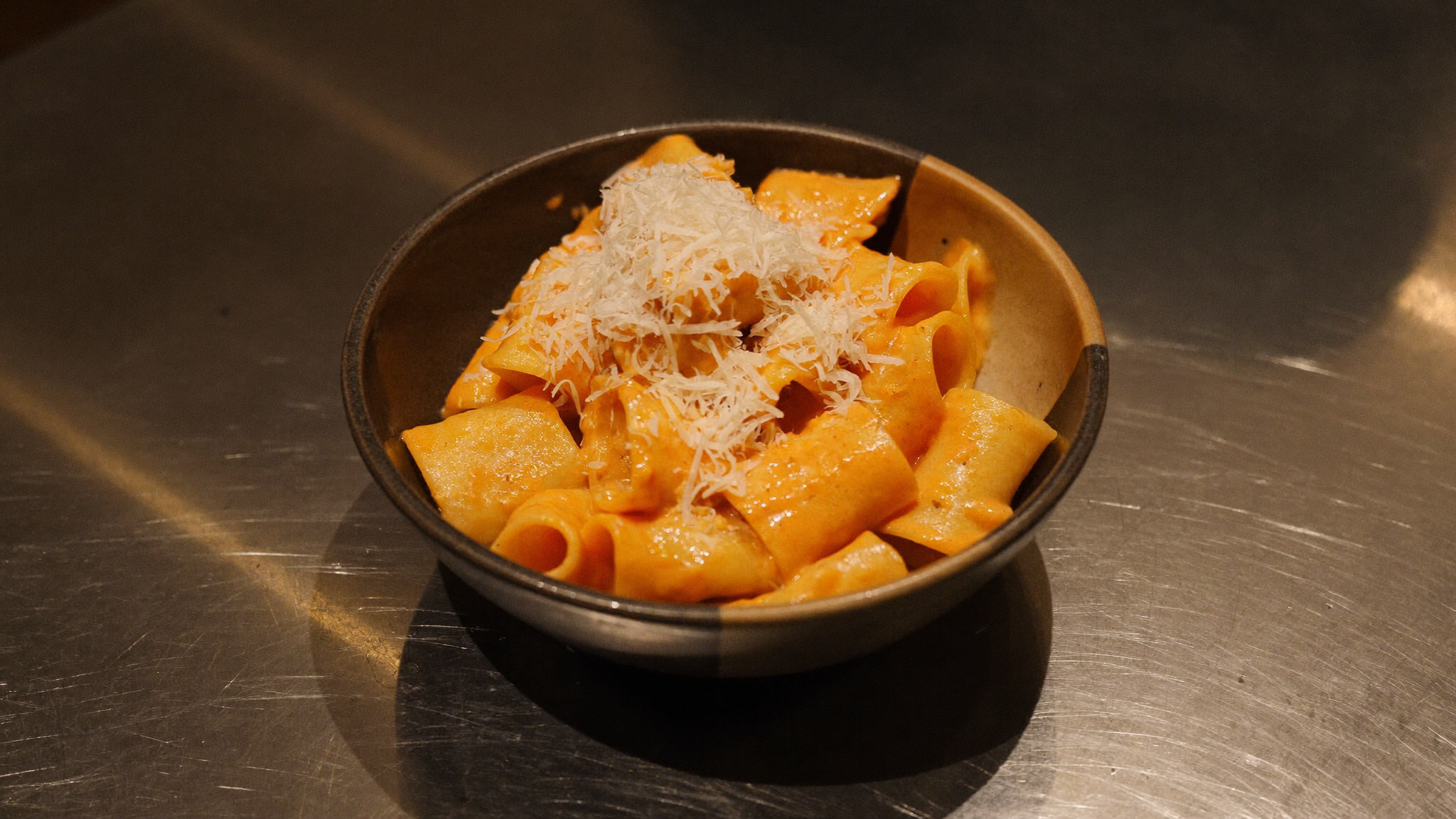
Listed as Rigatoni alla Vodka at $31, on a contemporary Italian menu that also carries a Bucatini Cacio e Pepe and a Tagliatelle Bolognese. The reason it earns a place here rather than being one more listing is context: this is a room in Gramercy Park where the vodka rigatoni sits beside the Roman and Emilian dishes rather than beside a chicken parm, which changes who the plate is for. It is the version to order when the table is split between someone who wants the comfort dish and someone who wants to eat something they have not had before, because both are on the same page.
The dining room seats 150 with a long bar, and reservations open 30 days ahead on OpenTable and Resy for parties up to ten, with walk-in space kept at the bar. Check Isabelle’s current menu before you go, since the pasta section moves with the season.
Best suited to: a mixed table, or a dinner where one person is not feeling adventurous and should not have to apologise for it.
Zero Otto Nove, 15 West 21st Street
Listed as Pollo Parmigiana alla Vodka, which is chicken parmigiana built on vodka sauce instead of plain tomato. This is a hybrid of two dishes that both arrived in America rather than Italy, served in a kitchen whose menu otherwise points hard at Salerno with a Rigatoni Salernitana and a Bistecca alla Salernitana. Lunch runs from noon most days and dinner from 5, closing at 9pm on Sundays.
Best suited to: the argument about whether chicken parm needs improving, settled in your favour or against you.
Don Angie, 103 Greenwich Avenue
Listed as Whole Roasted Lobster for Two at $135, with a smoked vodka sauce, spicy polenta tortelli and lobster polpette. Smoking the sauce is the kind of move that either justifies the price or makes you laugh, and I have not decided which. It is a dinner-only item. The restaurant opens at 5pm Monday through Thursday and 4pm Friday through Sunday, with a last seating at 10:30pm, and books through OpenTable.
Best suited to: an occasion, or a very committed argument about whether vodka sauce can be fine dining.
If the shape question here interests you more than the sauce, the same logic applies harder to a dish with fewer ingredients, which is the subject of seven cacio e pepe bowls and what the shape does to each. And if you are chasing any of these after 10pm, the published closing times are collected here.
Frequently Asked Question
Is there actually alcohol left in vodka sauce?
A small amount, usually. The common claim that alcohol boils off completely is wrong: how much remains depends on how long the sauce simmers after the vodka goes in, how wide the pan is, and whether it is covered. A sauce finished quickly can retain a noticeable fraction of what went in, while one held at a simmer for half an hour retains very little. In practice the amount on a single plate is small, but it is not zero, which matters if you are avoiding alcohol for medical or religious reasons or feeding a child. Ask the kitchen rather than assuming. Most will tell you plainly, and several will offer the same pasta with a plain tomato sauce.
Before you go
Pasta sections turn over with the season and vodka sauce is not always a permanent fixture. Everything above was read from each restaurant’s own menu in early August 2026. Check the current one before you cross town for a specific plate.
Hero image is an illustration and not a photograph of any restaurant listed above.
Editor’s note: Isabelle’s Osteria is affiliated with this publication. Restaurants were selected using the criteria described above.